
 雷科技
雷科技





When DeepSeek V3 launched last year, the atmosphere across the AI community was entirely different from what it is this year.
Discussions were extremely lively—almost reminiscent of ChatGPT’s initial global explosion. Social media feeds were flooded with hands-on tests, benchmarking results, and cost analyses. Many overseas developers engaged in serious, in-depth discussions about a Chinese large language model (LLM) company for the first time. Both domestic firms and Silicon Valley players realized that, beyond OpenAI, Anthropic, and Google, there existed teams capable of building models at this level of sophistication.
Even more crucially, DeepSeek’s offering was affordable. Its impact extended well beyond technical innovation: lower training costs, more aggressive engineering optimizations, and significantly higher reasoning cost-efficiency forced the entire industry to rethink the competitive logic of large models. Many hailed it as the true “Open AI.”
Two weeks ago, DeepSeek V4 launched—and while the industry paid close attention, and many developers immediately ran tests and comparisons, overall market sentiment was markedly more subdued. Over the past two weeks, ordinary users continued using Doubao or ChatGPT as before; among developers, many who rely on Codex or Claude Code did not switch to GPT-5.5 or Claude 4.6/4.7—even though DeepSeek V4 is cheaper.
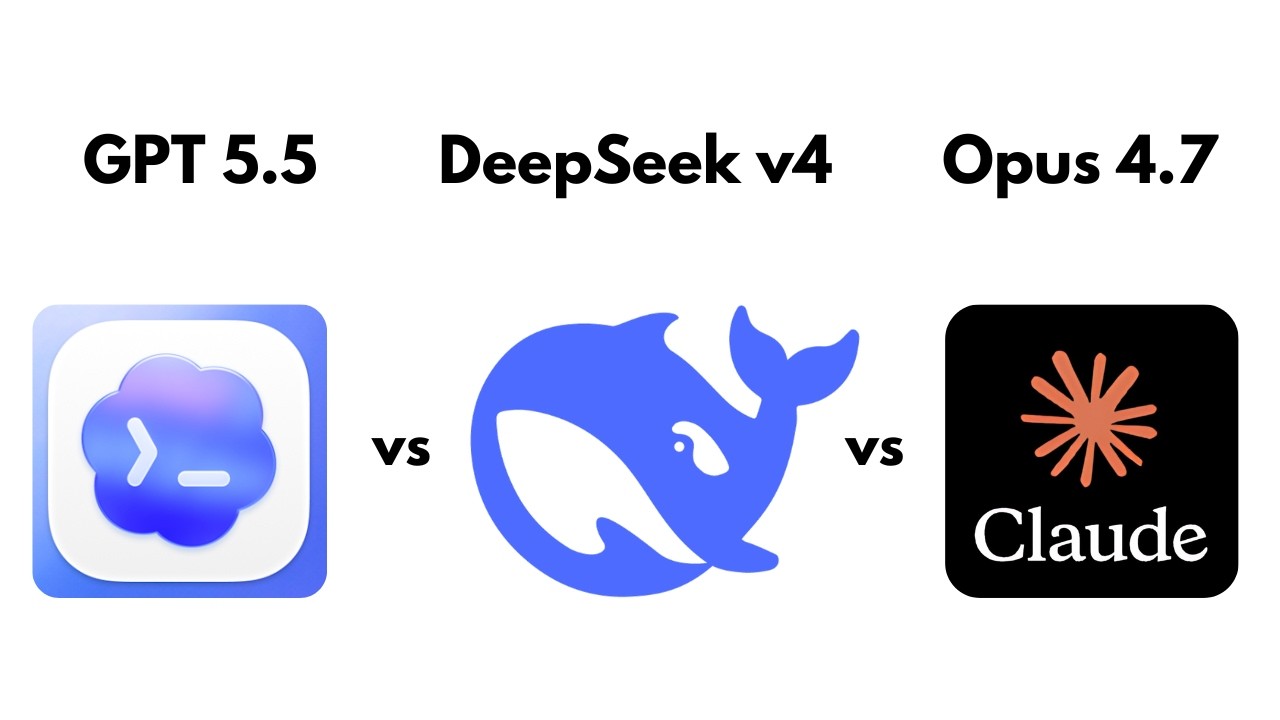
Image Source: YouTube
In fact, many developers now discussing AI barely mention model names like GPT-5.5, Claude 4.6, or DeepSeek V4. Instead, conversations revolve around Agent frameworks such as Codex, Claude Code, OpenClaw, OpenCode, and Hermes.
Indeed, over the past year, the AI industry’s competitive focus has gradually shifted—from raw model capabilities toward tangible, real-world output value. On this front, DeepSeek V4 still lacks its own “Codex.”
DeepSeek V4 Is Excellent—But Nobody’s Focusing on Models Anymore
“I tried the same operation on OpenCode: under DeepSeek V4 Pro’s ‘high’ mode, performance was shockingly slow. The same task took only 20 minutes in Codex 5.5’s ‘med’ mode—but over two hours on V4 Pro,” recently noted X user Ayush Jaipuriar.
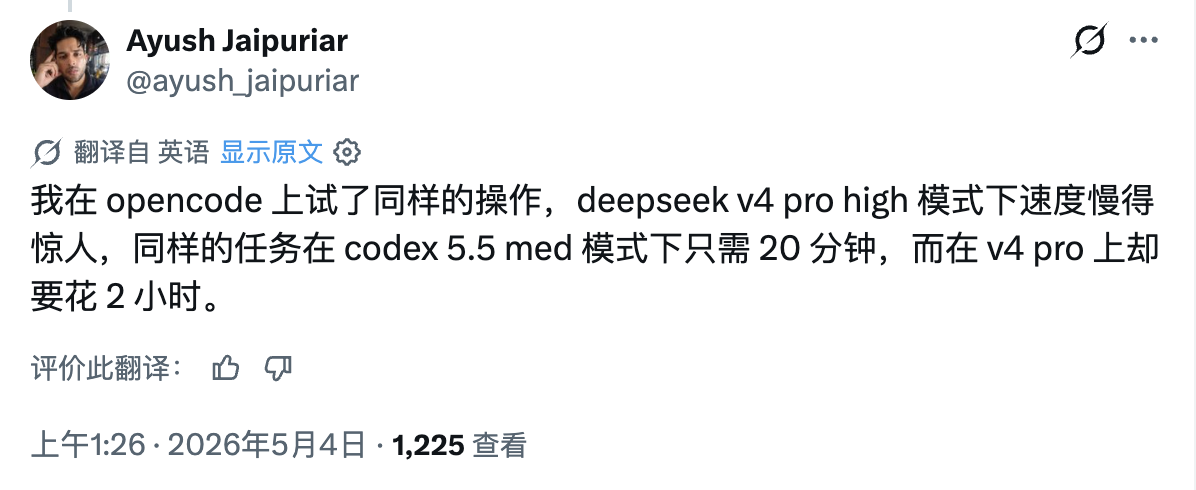
Image Source: X
To be clear, DeepSeek V4 is undeniably a powerful model. Its coding proficiency, reasoning ability, long-context handling, and multi-turn comprehension have all improved noticeably over V3—especially in Chinese-language scenarios, complex logical reasoning, and long-context understanding. Meanwhile, amid a widespread pricing surge across major LLMs globally, V4 stands out as one of the few models to actually reduce prices.
Yet the issue is that, in 2026, standardized benchmark scores increasingly fail to reflect AI’s real-world performance in practical workflows. Last year, each new model launch triggered immediate social-media chatter about surpassing rivals on MMLU, setting new records on SWE-Bench, or gaining incremental improvements in human evaluations.
This isn’t to say benchmarks are entirely meaningless—but developers clearly care less about them now. The reason is straightforward: they’ve seen too many models that score exceptionally well on benchmarks yet deliver poor usability in practice. Benchmarks resemble exams; real-world work environments are far more complex—and actual task execution often matters more than price advantage.
Semiconductor and AI analysis firm SemiAnalysis recently conducted a comparative evaluation covering GPT-5.5, Opus 4.7, and DeepSeek V4, concluding that DeepSeek V4 represents the lowest-cost top-tier closed-source model alternative available today—though its capabilities still fall short of industry leaders.
Moreover, token-based cost calculations are fundamentally flawed. A more meaningful metric is the total cost required to complete an actual task. Wang Boyuan, a developer and former media professional, pointed out on X that a problem he struggled to solve using a near-top-tier domestic model was resolved instantly using Codex. Similarly, Chi Jianqiang—developer and founder of Mo Wen Xi Dong—reported that Claude Code failed twice to resolve a given issue, whereas Codex succeeded on the first attempt.
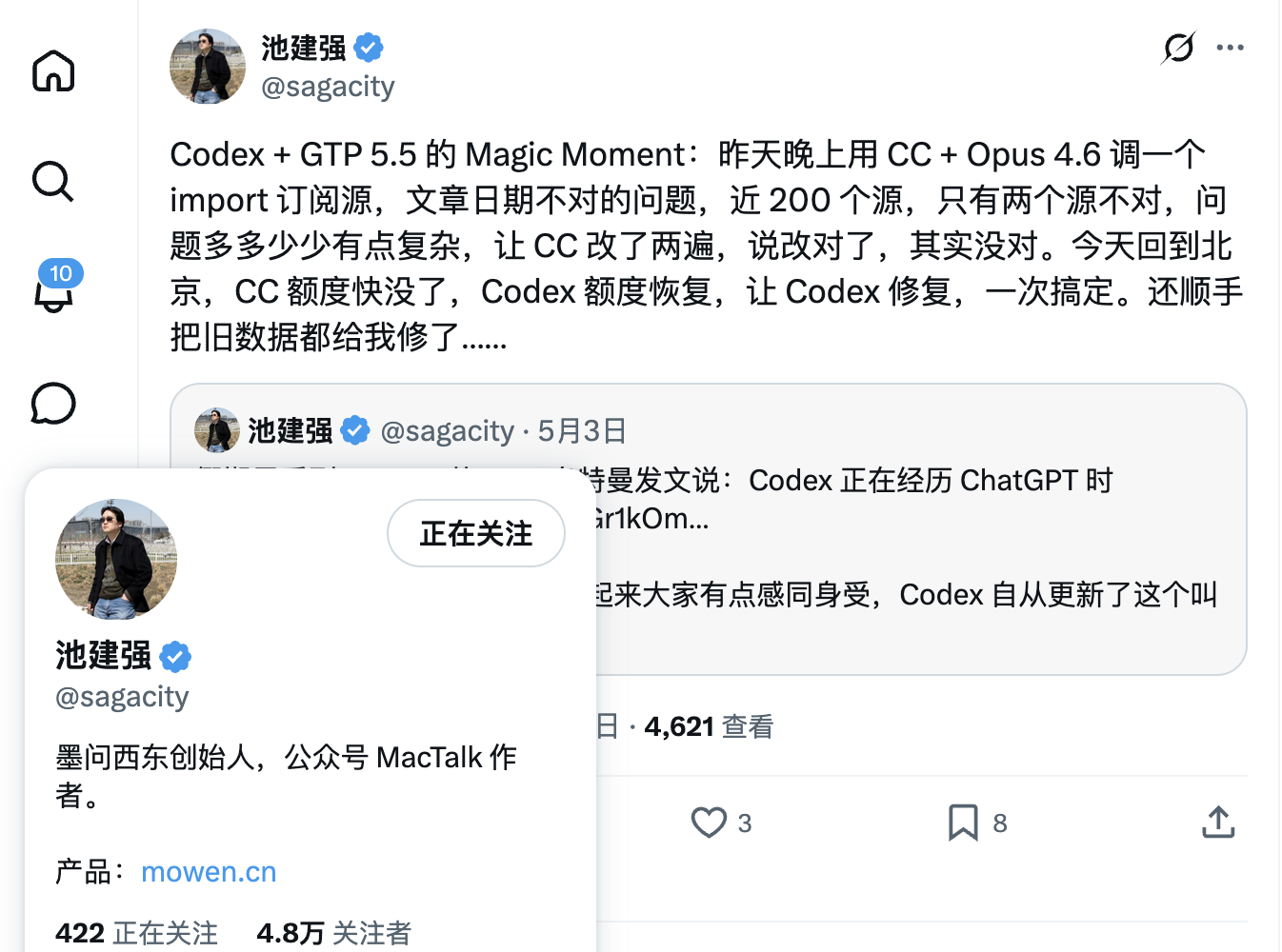
Image Source: X
Clearly, real-world model cost cannot be assessed by simply comparing official token pricing—let alone outcomes; even the actual token consumption varies significantly across models. Notably, one of GPT-5.5’s key upgrades this time is enhanced “efficiency”: completing identical tasks using fewer tokens.
Thus, even though third-party models—including DeepSeek V4—can technically be integrated into platforms like Claude Code or Codex, considerations of stability, effectiveness, and time-to-completion mean most users still default to official models: Claude Code uses Claude 4.x, and Codex uses GPT-5.x.
This holds especially true in coding scenarios, where developers face daily challenges centered on whether AI can truly participate in end-to-end software engineering workflows—such as comprehending full project structures, persistently modifying dozens of files, autonomously invoking terminals, self-correcting bugs, retrying after errors, and maintaining stable context over extended durations.
These requirements test far more than raw “model capability”; they demand a fully integrated AI workflow system. Developer Vladimir, after consuming 14.43 million tokens with DeepSeek V4, observed that V4’s intelligence level approximates GPT-5.2/GPT-5.3—but its biggest flaw is frequently ignoring agent-related files. In practice, he reported needing to explicitly enforce tool usage and Harness framework invocation.
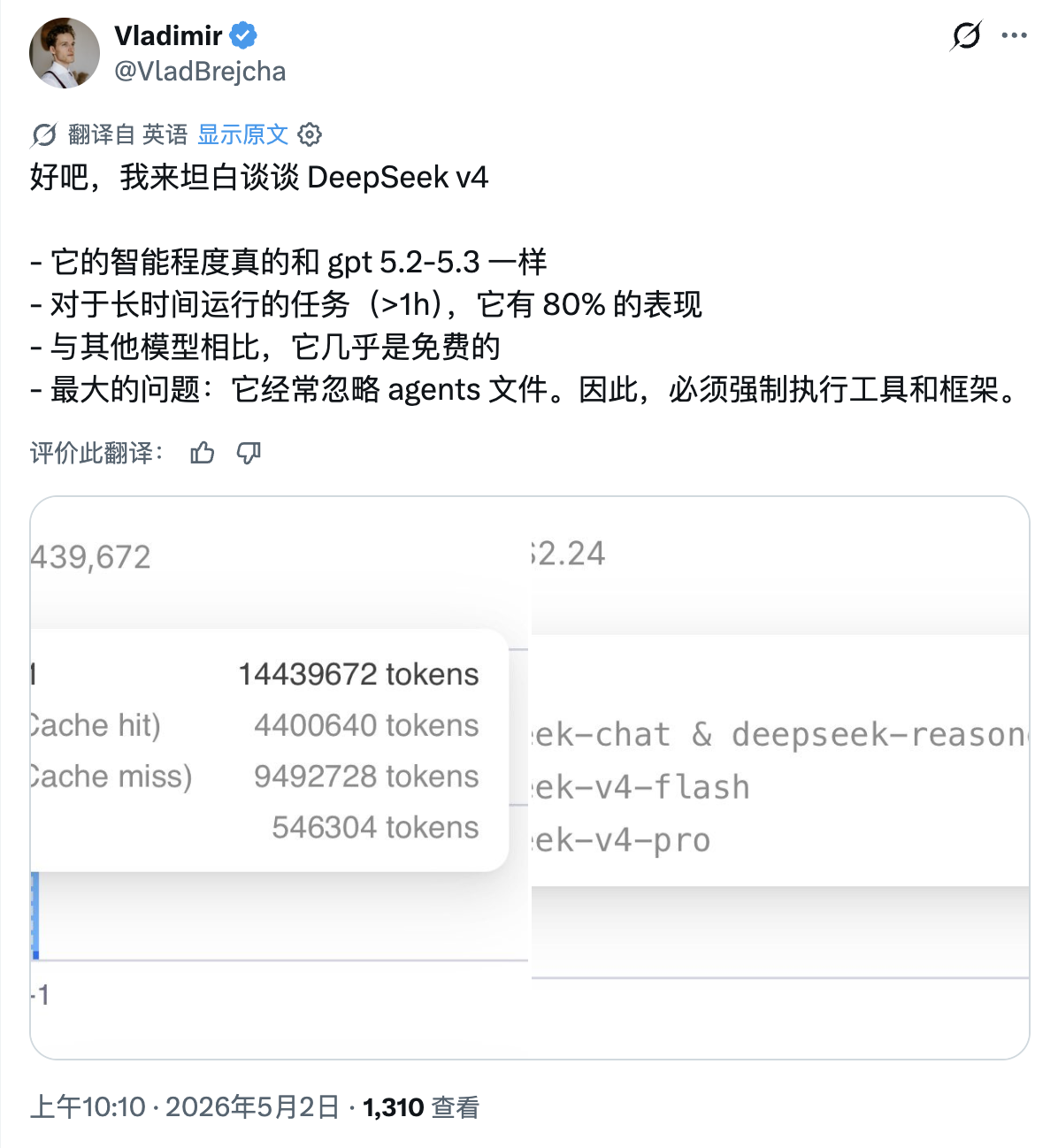
Image Source: X
Claude Code and Codex are genuinely complete products—whereas DeepSeek V4 remains just a model. SemiAnalysis emphasized in its testing report: “A truly complete product comprises both a runtime framework and a model. Missing either component leaves you critically incomplete.”
Over the past year, Agent frameworks like OpenClaw (“Lobster”), Claude Code, and Codex have grown increasingly prominent. Many developers no longer say, “I’m using Claude 4.6”—they say, “I’m using Claude Code.” Likewise, discussions increasingly center on “Codex,” not “GPT-5.5.”
DeepSeek Still Needs Its Own Codex
Looking back at ChatGPT’s early breakout, many now realize the entire industry was initially focused on building “conversational” products. Whether OpenAI, Anthropic, or domestic vendors, the core objective was making models behave more like humans in dialogue—prioritizing intelligence, naturalness, and human-like authenticity.
Today, however, AI’s focus is shifting decisively from “chatting” to “working.” This may appear superficially like a simple change in use case—but it fundamentally reshapes the industry’s competitive logic. Previously, model companies’ top priority was training smarter models; today, the critical challenge is enabling AI to reliably execute real tasks.
That’s why terms like Agent, Workflow, Context Engineering, and Harness Engineering have surged across the industry over the past year. At their core, they all address the same question: How do we embed AI meaningfully into production workflows?
Accordingly, when developers evaluate AI coding tools or Agent products today, the underlying model—while vital as the system’s “engine”—is no longer the sole determinant of practical value. What matters more is the holistic systems engineering: context management, tool invocation, long-term memory, task decomposition, error recovery, and multi-Agent coordination. In real-world applications, these capabilities often outweigh raw model advantages.
Image Source: X
This is also why more and more people now argue that AI coding competition has evolved beyond LLM rivalry into “AgentOS” competition.
Conversely, this helps explain Claude Code’s and Codex’s success. Their strength stems not only from proprietary models’ technical leadership but also from deep vertical integration—from foundational models up through Agent frameworks—delivering greater stability and efficiency in real-world environments. Especially for extended tasks, Claude Code functions more like an autonomous AI assistant capable of sustained, independent operation.
GPT-5.5’s significance lies not merely in superior model capabilities, but also in Codex’s increasingly mature workflow architecture—encompassing file management, tool invocation, Agent coordination, task decomposition, and context management. The synergistic effect of these features has yielded qualitative leaps in real-world AI performance and value.
OpenAI recently announced that API revenue from GPT-5.5 grew more than double the rate of any prior version within its first week—and Codex’s revenue doubled in under seven days. Moreover, this advantage is now extending beyond AI coding into broader Agent-driven applications.
Observers tracking Anthropic and OpenAI will note both companies are rapidly expanding Claude Code and Codex into new domains—including deeper integrations with third-party applications and platforms.
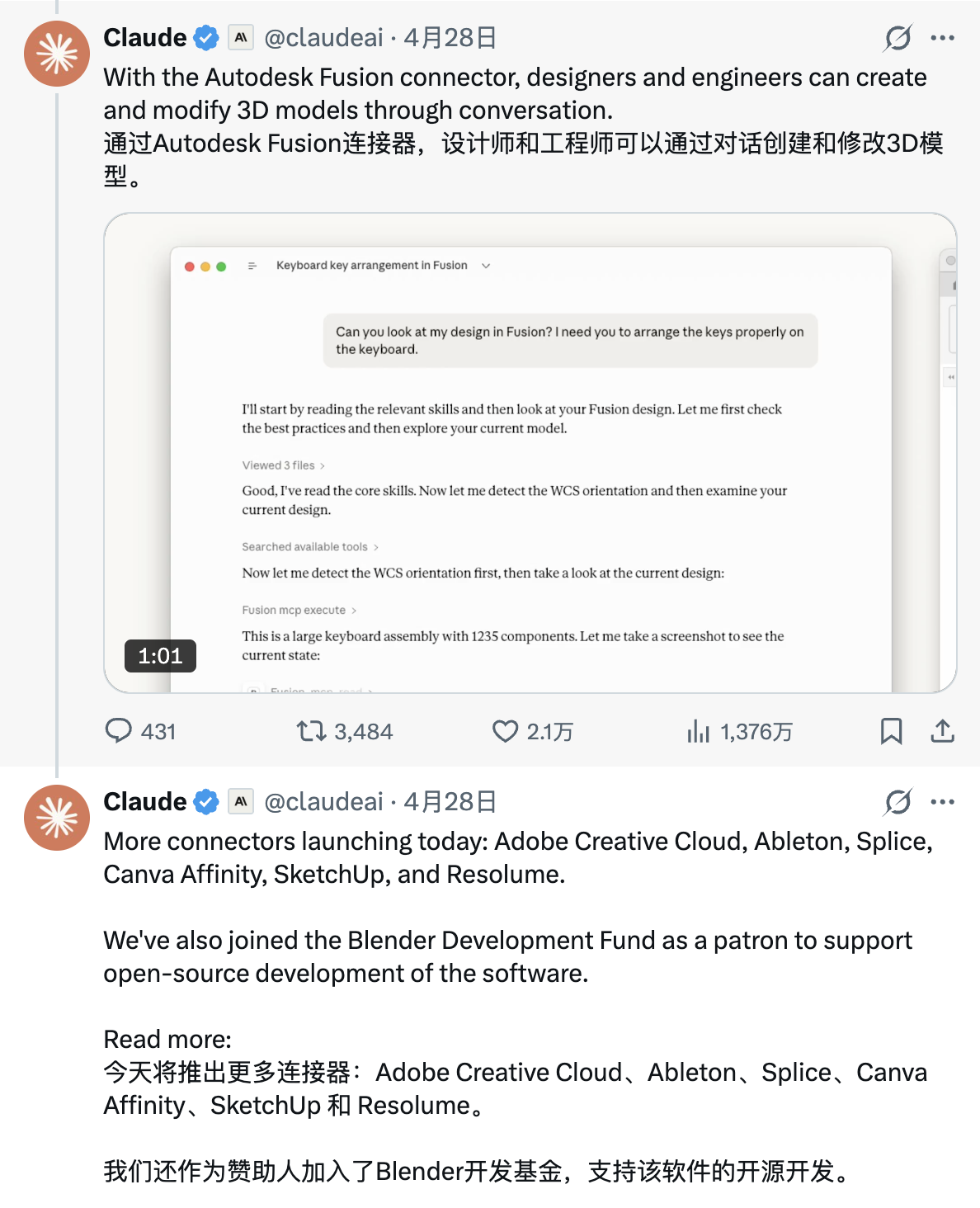
Image Source: X
Further, Claude Code increasingly aligns with Claude Cowork’s workplace productivity positioning, having recently launched a banking- and financial-services-specific AI Agent. Codex, meanwhile, emphasizes research, documentation, accounting, and other knowledge-work tasks—not just coding.
Revisiting DeepSeek V4, while it has already caught up with industry-leading models at the architectural level, it still lacks its own “Codex.” In fact, demand for such a framework is already substantial. A GitHub repository even hosts DeepSeek TUI—an open-source terminal-based Coding Agent built on DeepSeek V4, supporting Skills and numerous common Agent-framework functionalities.
Yet this remains a third-party effort. Its understanding of DeepSeek V4 inevitably falls short of the official team’s depth—and thus cannot fully leverage V4’s potential for vertical integration. The best hope is that feedback and momentum generated by DeepSeek TUI will spur DeepSeek’s official team to develop its own open-source Agent framework—its own Codex.

