
 雷科技
雷科技






AR glasses are finally starting to look—and behave—like true AR glasses again.
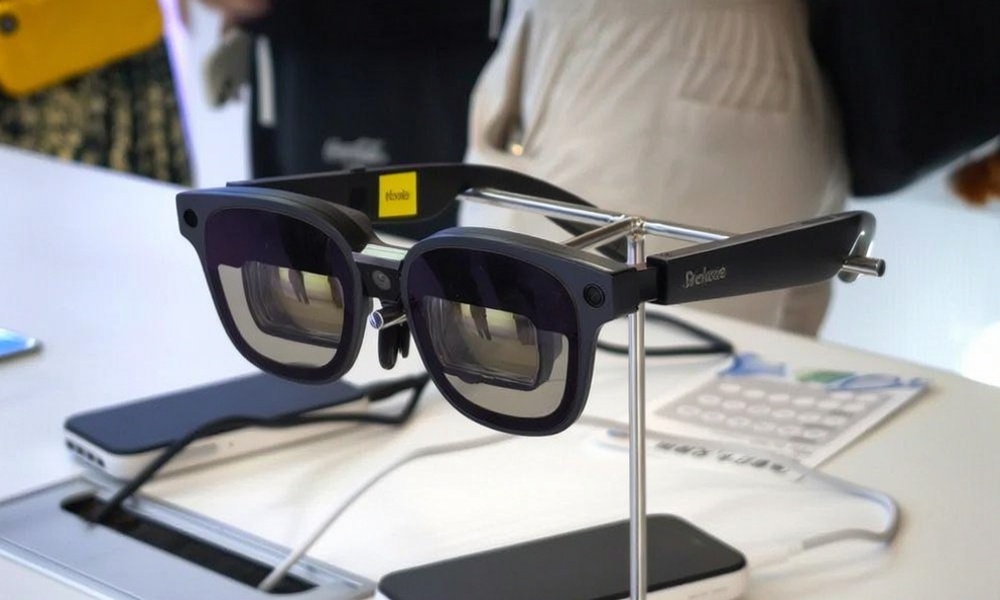
Recently, LeiTech attended Rokid Open Day 2026, where the next-generation spatial computer—the Rokid AR—was unveiled ahead of its official launch. Based on official disclosures and firsthand observations by LeiTech, the Rokid AR continues with a split-body design. Its compute unit is powered by a platform equivalent to Qualcomm’s fifth-generation Snapdragon 8 Gen 3 Premium Edition and supports full 6DoF spatial tracking.
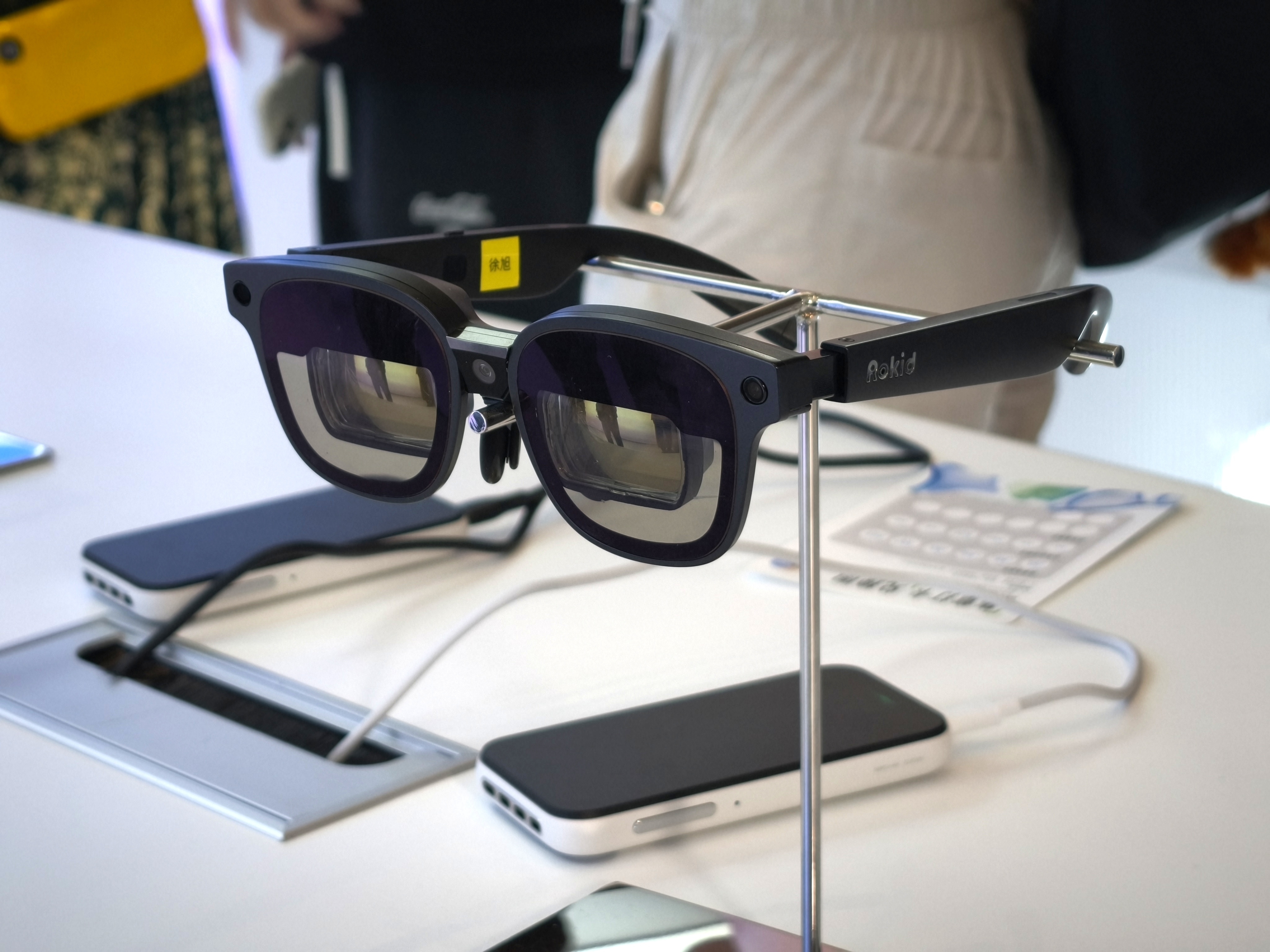
Rokid AR prototype at Open Day; Image source: LeiTech
Rokid even separates the “spatial camera” from the “AI camera”: the former handles position and environment perception, while the latter interprets what users see in front of them. Coupled with a dedicated spatial computing co-processor, the glasses can render advanced spatial content—including 4D Gaussian splatting.
But this shift isn’t unique to Rokid.
At the end of 2024, XREAL launched its One series, integrating proprietary X1 chips to enable native 3DoF tracking directly within the glasses. In 2025, VITURE unveiled the Beast and soon followed up with native 3DoF support on-device. This May, RayNeo released the GT and GT Max models—both featuring dedicated spatial computing chips and native 3DoF capabilities.
Moreover, the XREAL One Pro—when equipped with an add-on camera—can support 6DoF tracking, and the VITURE Luma Ultra already employs environmental cameras to explore full spatial localization.
A brief explanation: 0DoF content remains fixed at the center of the user’s field of view; 3DoF tracks head rotation (pitch, yaw, and roll), anchoring the display to a specific orientation; 6DoF adds positional tracking—enabling detection of forward/backward, left/right, and up/down movement.
In just two years, nearly all major consumer-grade AR glasses manufacturers have pivoted toward robust spatial tracking.
This trend feels somewhat counterintuitive. Just a few years ago, the consumer AR industry was doing exactly the opposite: removing cameras, abandoning full spatial awareness, steering away from complex AR applications—and instead focusing almost exclusively on portable, large virtual-screen displays. In short, they were settling for being “displays.”
After circling back, not only has 3DoF returned—but full 6DoF is making a comeback too.
AR Glasses Once Voluntarily Gave Up on AR
Consumer AR glasses never lacked ambition in spatial computing.
The Nreal Light—debuted in 2019 (later rebranded as XREAL)—already featured environmental-sensing cameras supporting 6DoF tracking. When worn, users could anchor digital objects in physical space, walk toward or away from them, or orbit around them. Microsoft’s HoloLens and Magic Leap went even further, incorporating room scanning, gesture interaction, and deep environmental understanding.
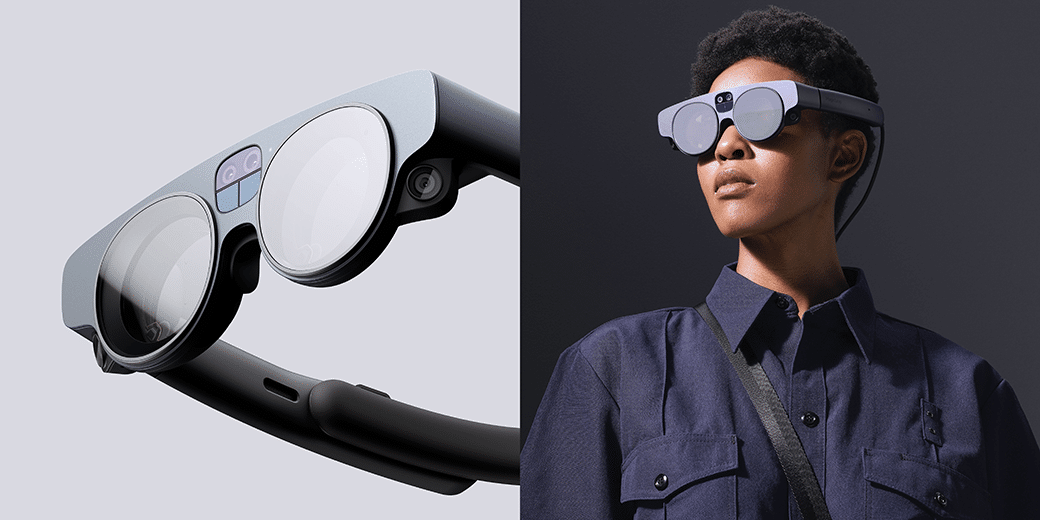
Magic Leap 2; Image source: Magic Leap
Products soon collided with reality.
Full 6DoF tracking demands cameras, IMUs, SLAM algorithms, and a continuously operating compute platform. Cameras must observe the environment; chips must process real-time data on user location and head orientation—and determine precisely where digital content should be placed. The result? Higher power consumption, noticeable thermal output, more complex mechanical designs, and greater difficulty achieving low weight and affordable pricing.
Content ecosystems posed an even thornier challenge. Mobile apps can be rendered directly onto flat, 2D screens—but cannot be transplanted unchanged into 3D space. Developers must redesign UIs, interactions, and content from scratch. Meanwhile, users who purchased AR glasses struggled to find compelling, long-term spatial applications.
The tech demos looked dazzling—but no one knew what to actually *do* with them.
So beginning around 2021, consumer AR glasses collectively embraced simplification. Following the Nreal Light, the Nreal Air dropped comprehensive environmental sensing—shifting focus to Micro-OLED displays, Birdbath optics, and USB-C video input. Subsequent models—including the Rokid Max, RayNeo Air, and VITURE One—followed similar paths:
No longer obsessed with room recognition or understanding furniture and walls—simply plug in your smartphone, laptop, Nintendo Switch, or Steam Deck, and instantly project a virtual screen measuring 100–200 inches.

Image source: RayNeo
Simple. Direct. And genuinely useful. On airplanes, high-speed trains, or in hotel rooms, users no longer need to carry bulky external monitors—or fully occlude their surroundings like VR headsets do. Video streaming platforms, console games, and desktop workflows are ready-made content sources—no need to wait for a nascent “spatial ecosystem” to mature.
Fairly speaking, this strategic retreat helped consumer AR glasses finally land on a viable commercial footing.
The trade-off? Many so-called AR glasses had little to do with AR anymore. Their displays remained rigidly centered in the user’s field of view—moving wherever the head turned. These devices couldn’t perceive real-world space or determine where the virtual screen should remain anchored. Strictly speaking, they functioned more like head-mounted displays—yet both manufacturers and markets continued calling them “AR glasses.”
Even basic 3DoF wasn’t standard for much of this period.
6DoF Spatial Tracking Is Making a Comeback
For glasses primarily used for watching movies, 3DoF is already crucial—it determines whether users feel they’re “looking at a screen in front of them,” versus staring at a flat image permanently glued to their face. So even as the industry retreated to cinematic-display positioning, 3DoF never fully disappeared.
Over the past two years, 3DoF has reemerged as a standard feature across many consumer AR glasses. The XREAL One, VITURE Beast, and RayNeo GT series all embed spatially stabilized screen anchoring directly into the glasses themselves. Users no longer require special host devices or dedicated software—stable, large-screen viewing has become a foundational experience.
Yet that’s only step one. While 3DoF answers “should the screen follow my head?” 6DoF answers “should content persist in the world?” When glasses only track head rotation, the screen can merely stay fixed in a given direction. But once they begin interpreting changes in the user’s physical position within space, digital content truly gains the potential to “live in reality.”
That’s why, after implementing 3DoF, manufacturers quickly refocused on 6DoF.
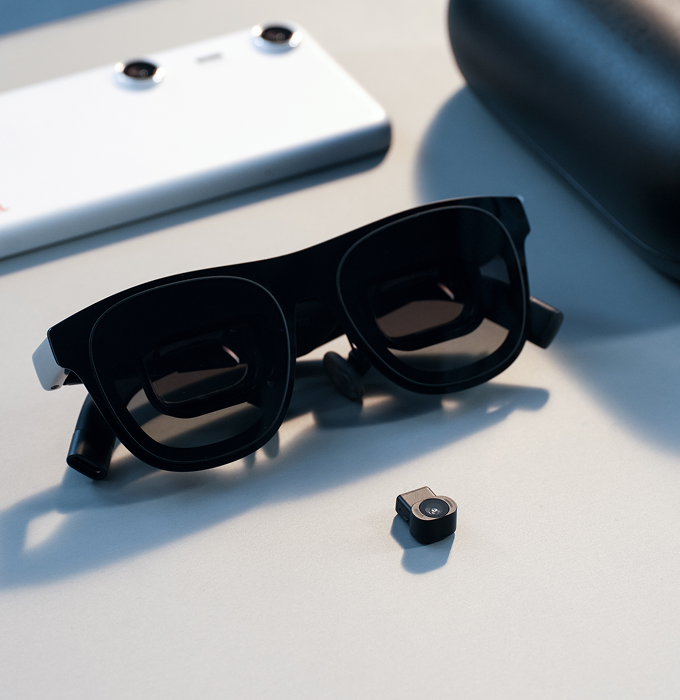
XREAL One Pro with magnetic-mount external camera; Image source: XREAL
XREAL was among the earliest to revisit this path. After launching the One series, it introduced the One Pro—supporting magnetically attached external cameras—to augment environmental sensing and deliver foundational 6DoF spatial tracking. Compared to static screen anchoring, this means virtual windows can now genuinely “stay in the room”: users can approach, retreat, or circle around them—and the visuals maintain correct spatial relationships.
Adding two cameras may seem minor—but it represents a fundamental shift: from “display device” back to “spatial device.”
VITURE took a comparable route. Its Beast model first integrated native 3DoF to solve basic spatial stability; later, the Luma Ultra added environmental cameras to explore full 6DoF capability—not just stable large-screen viewing, but true spatial anchoring.
Luma Ultra; Image source: VITURE
RayNeo remains at the 3DoF stage for now—but its GT series’ inclusion of a dedicated spatial computing chip signals clear preparation for more sophisticated spatial perception. In other words, 3DoF is effectively a transitional phase—not the final destination.
At Open Day, Rokid’s next-generation AR positioned 6DoF as a core capability—and explicitly differentiated between “spatial cameras” and “AI cameras.” The former handles localization and environment modeling; the latter interprets what users see. Together with an external compute unit, they enable advanced spatial computation.
Consumer AR glasses have come full circle—returning to early ambitions, albeit along a far more pragmatic path. But why are manufacturers once again investing in cameras, 6DoF, and full spatial computing?
AI Weaves Through Content, Computation, and Interaction—Timing Aligns Perfectly
AI is the indispensable variable.
Historically, AR faced an awkward dilemma: *What should live in that space?* Developers needed to pre-build 3D models, scenes, and applications—then wait for users to launch them manually. Yet content development was prohibitively expensive, while user bases remained tiny—making it impossible to break the chicken-and-egg cycle.
Generative AI transformed where 3D content comes from. On one hand, 2D-to-3D conversion technologies have matured significantly; combined with rapid iteration in world models and specialized 3D generation models, they’re poised to reshape the future of spatial content ecosystems. Meanwhile, advances in multimodal AI and large language model (LLM) ecosystems are steadily turning previously speculative capabilities into reality:
For example: when a user looks at an unfamiliar device, the glasses recognize its model and overlay step-by-step instructions near the relevant buttons; at an intersection, navigation arrows appear precisely where a turn is required; during conversations with foreigners, translated subtitles appear in the direction of the speaker.
AI determines *what* users need; AR glasses decide *where* that information should appear. Without AI, AR glasses would still depend entirely on limited, pre-built applications for content. Without AR glasses, however, AI outputs would remain mere notifications—floating unanchored in the user’s field of view.
Chips are evolving too. Early lightweight AR glasses struggled to handle visual-inertial odometry, graphics rendering, and AI inference simultaneously. When Qualcomm launched the Snapdragon AR2 Gen 1 in 2022, it adopted a distributed multi-chip architecture—halving power draw while boosting AI performance—specifically to bring spatial awareness to thinner, wireless AR glasses.
Today, we see two parallel trends: low-power spatial chips like the XREAL X1 and RayNeo Zone 360—dedicated to IMU processing, frame reprojection, and stabilization—and increasingly powerful mobile-class and XR compute platforms handling visual understanding, graphics rendering, and on-device model inference.
Rokid’s next-gen AR—combining on-glasses chips with a Snapdragon compute unit—follows this same architectural philosophy: lightweight glasses handle display, sensors, and ultra-low-latency processing, while heavier AI and spatial computations run externally.
Interaction has also found better solutions. Past AR glasses often forced users to treat smartphones as touchpads—or raise arms for unstable mid-air gestures. Visually futuristic, yet practically cumbersome.
Large language models have elevated voice interaction beyond simple command recognition—they now understand continuous intent and contextual nuance. Users don’t need to master a new spatial interaction vocabulary. Simply gaze at an object and say, “What is this?”, “Translate this for me”, or “What’s the next step?”—and the glasses fuse vision, speech, and spatial context seamlessly.
Of course, voice won’t replace all interaction modalities. Clicking buttons or moving windows still requires gestures, rings, or other input peripherals. But AI has dramatically lowered the barrier to entry for spatial computing.
Content, chips, and interaction—once divergent technical threads—are converging under AI’s influence. As the ancient saying goes: “When timing aligns, heaven and earth unite their strength.” It fits AR glasses today perfectly.